
What I Got:
- Juliet Takes a Breath (1st Edition) by Gabby Rivera
- Can I Say by Travis Barker
- Rolling Stone, July 2020, Issue #1341
- Transgender History: The Roots of Today’s Revolution (Revised Edition) by Susan Stryker
- What Storm, What Thunder (ARC) by Myriam J.A. Chancy
- Things Are Against Us (ARC) by Lucy Ellmann
- Eat Up! by Ruby Tandoh
- All the Wrong Questions #1: “Who Could That Be At This Hour?” by Lemony Snicket
What I Read:
- We Are the Weather: Saving the Planet Begins at Breakfast (audiobook) by Jonathan Safran Foer
- Intimations by Zadie Smith
- The Unbeatable Squirrel Girl, Vol. 1: Squirrel Power by Erica Henderson, Ryan North, Wil Moss, Maris Wicks, Kyle Starks, Chris Giarrusso, & Rico Renzi
- The Hilarious World of Depression by John Moe
- Wow, no thank you by Samantha Irby
- Self Care by Leigh Stein
- Make Time: How to Focus on What Matters Every Day by Jake Knapp & John Zeratsky
- How to Be Ace: A Memoir of Growing Up Asexual by Rebecca Burgess
- The Girl from the Sea (old ARC) by Molly Knox Ostertag
- Things Are Against Us (ARC) by Lucy Ellmann DNF
- All the Places In Between by John Cei Douglas
- Started Because Internet: Understanding the New Rules of Language by Gretchen McCulloch
- Concrete Kids (Pocket Change Collective) by Amyra León
Does anybody else find it incredibly strange that it’s August already? Wasn’t it just March? Anyway, as promised, a lot of my reading this month has been no-bullshit nonfiction, with a few graphic novels thrown in there and one novel.
I have to admit, by the end of this month, I became a little burnt out from all the nonfiction, which is why I wasn’t able to finish Because Internet. I don’t do this often, but it’s a book that I’m still interested in, so I’m going to take a break and come back to it when I’m ready to actually learn some shit about linguistics. (Because, yes, I am a word nerd…)
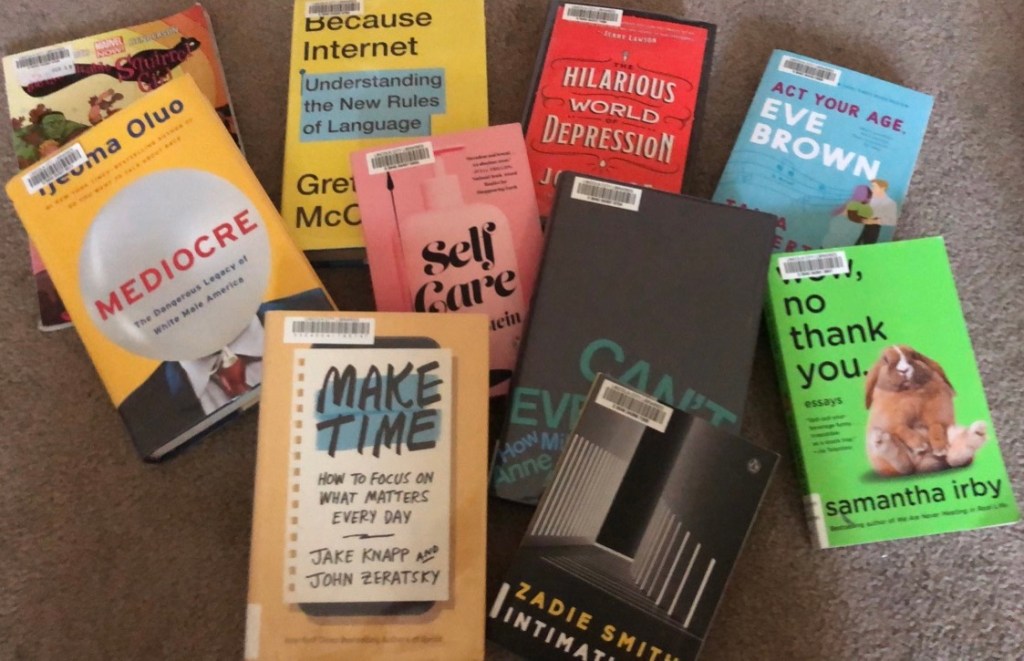
I got quite a few of these book titles from this article that pairs books with songs from Bo Burnham’s Inside, and because I wasn’t in a good headspace, I figured some of these books might mirror what I was actually feeling at the moment. And you know what? Most of them did.
Jonathan Safran Foer has written a different book I’ve heard of called Eating Animals about vegetarianism, but I was more interested when I saw that he had a book about the environment and how our lives can help and hinder the healing of the planet. I was surprised to find that it was very similar to John Green’s book of essays in many ways.
And because I read this so soon after reading The Anthropocene Reviewed, I couldn’t help but compare the two. Both are introspective and existential and use specific details and stories to make points. A lot of times while listening to this book, I would think, “Oh, this sounds like a John Green quote.” And because John Green’s book hit home more often and JSF was telling me a lot of things I already knew, I liked John Green’s better. But that isn’t to say I didn’t like this book. I just wasn’t as engaged.
I appreciate the argument that JSF is making, but he gets there in ways that I sometimes disagree with. Like that obesity is a “trend” or that low-income families should still be able to eat a healthy diet just because it is affordable in some ways. Or comparing climate change and our lack of collective action to suicide. He oversimplifies things at the same time that he complicates things, which makes it seem like he just picks and chooses convenient facts.
Also, there’s a point in the book when he says that his point is to convince people to eat less meat because factory farming is bad for the environment, and then the entire book is not that. I am kinda glad it ended up being a more comprehensive guide to being more environmentally conscious, but that short little moment threw me off.
The best part about this book is its changing narrative styles. A lot of it is written like a regular nonfiction book of connected essays. Part of it is a conversation with himself. Part of it is addressed to his kids. He brings back facts and stories that he has already told at great moments to punctuate his arguments. So… not a bad book, but not the best book, either.
Alright, I promise all of these reviews won’t be that long. I just apparently had a lot of thoughts on this book!
A book of pandemic essays was just what I needed while stuck in a depression rut. In Intimations, there was no skirting around the truth or forced hopefulness. The essays are not hopeless, far from it actually, and discuss life as it is being experienced rather than one big reflection on life. When Zadie Smith talks about people, she makes them full and vibrant; she attributes meaning to their lives without making it seem like their meaning is to be a side character in her story. She reminds us to constantly and reflexively imagine the whole, complex life behind a person and their behavior.
My favorite essays were “Something To Do”—because it discusses art, creating art, and the idea that we have to fill time, while also addressing that everyone feels the effects of isolation differently—and “Suffering Like Mel Gibson”—which confronts the tendency to compare suffering when, in fact, a person who is suffering is always just a person who is suffering. Smith urges readers to have patience with those whose suffering may seem minimal or less important.
I have to admit that I was a bit disappointed with The Unbeatable Squirrel Girl. It was cute, but I found myself just wanting to be done with it, even though it’s about a queer and quirky Marvel superhero that, you guessed it, has squirrel powers. Nice idea, but didn’t quite hit the mark.
The Hilarious World of Depression is exactly what it sounds like—a funny recounting of John Moe’s life with depression and his interviews with celebs (mostly comedians) who also have depression. This book was relatable and funny and sad all at the same time.
This book based on a podcast in which Moe interviews comedians about their depression, which sounds interesting, but the book didn’t hook me enough to make me want to listen to it. Partially because media with heavy themes of suicide, suicidal ideation, and/or severe mental illness can be incredibly difficult for me to consume. There were parts of this book, mostly the ones when he discussed his brother’s suicide or his own suicidal thoughts, that were hard to get through as well.

But it is nice to read about such a serious mental illness in a way that doesn’t romanticize it or, on the opposite end of the spectrum, completely ignore its gravity. The jokes and stories normalize the ridiculousness of depression and makes it less scary.
After this heavy read, the sass and sarcasm of Samantha Irby’s essays were a breath of fresh air. I enjoyed wow, no thank you a lot. As someone who also has chronic GI issues, I appreciated Samantha Irby’s stark honesty about her own GI issues. I was the kid who didn’t find it embarrassing to talk about poop or pee cuz it was normal for me and it’s nice to know that the embarrassment vs. fuck-it attitude war goes on inside someone else’s mind too.
The essays are very meandering, though generally stick with their themes, and also fully lacking in bullshit. No bullshit detected here. She talks about serious things in a way that makes it clear these are normal things for her, not cries for help or pity. Life is just like that sometimes. It can suck and be great, often at the same time.
The only thing I really didn’t vibe with was the repetition that she uses in some of the essays where every sentence/paragraph starts with the same thing. It either really worked for me or really didn’t. For example, I really enjoyed “Hello, 911?” immensely. It is an essay about anxiety, essentially, and how everything feels like an emergency when you are anxious all the time. And, like, MOOD. My “is this something to be anxious about or is this ridiculous?” meter is horrible. But the essay that started every sentence with “Sure, sex is fun, but have you ever..?” didn’t really have enough of a unified theme for me to understand the point it was really trying to make.
This is the first Samantha Irby book I’ve read (even though it is her most recent), but it did make me want to pick up her other books just for the no-bullshit humor and real talk about human bodies.
When I finished these no-bullshit essays, naturally I decided to pick a book that satirizes the self-care industry. Naturally, I wanted to go from no bullshit to purposeful bullshit. Naturally…
Self Care by Leigh Stein is a satire of the self-care/wellness industry and how it manipulates users by monetizing health and weaponizing trauma. Some of the blurbs on the book say that the reader laughed, but I didn’t find this book funny at all, really. Yes, it is ridiculous at times. But that just made the whole wellness industry seem more horrifying.
The dichotomy between the two main characters didn’t make sense at times, though I can see why it was done. It just never really made sense to me why they were friends except maybe because Maren is the only person who offered to help Devin after her dad died. And maybe that’s the point—only one person reached out, so only one person truly knows Devin. By the end, they’ve kind of switched roles, which is really clever.
I loved that Khadijah’s point of view was added. She had less of an emotional investment in the Richual brand than the other two, which gave her a mixture between an insider and outsider POV. She offered a much-needed break from Devin’s obsession with being perfect and Maren’s intensity in her job role.
Because I’m not very business or finance savvy, there were many points during which I wasn’t entirely sure what was going on and only understood the gist of it. This also might be because I don’t participate in online self-care culture and don’t understand the lingo.
The best part of this book is that it criticizes the self-care industry while also showing how it can help some people. It explores how wealth gives you both the power to change your situation and the ability to step away from a situation that isn’t healthy. I wish I had more insight to add to the topic that this book is in conversation with, but I just don’t know the wellness/self-care industry that well.
Then I picked up a book that I really could step into rather than feeling like I was looking through a window.. Like Loveless by Alice Oseman, I could see a lot of myself in Rebecca Burgess’s How to Be Ace. It was especially nice to see someone who is ace and has OCD, too. And to see two ace people end up in a loving relationship. The best kind of romance! And it’s a memoir, so it’s a real-life thing I can hope to have one day that’s not just in my imagination!
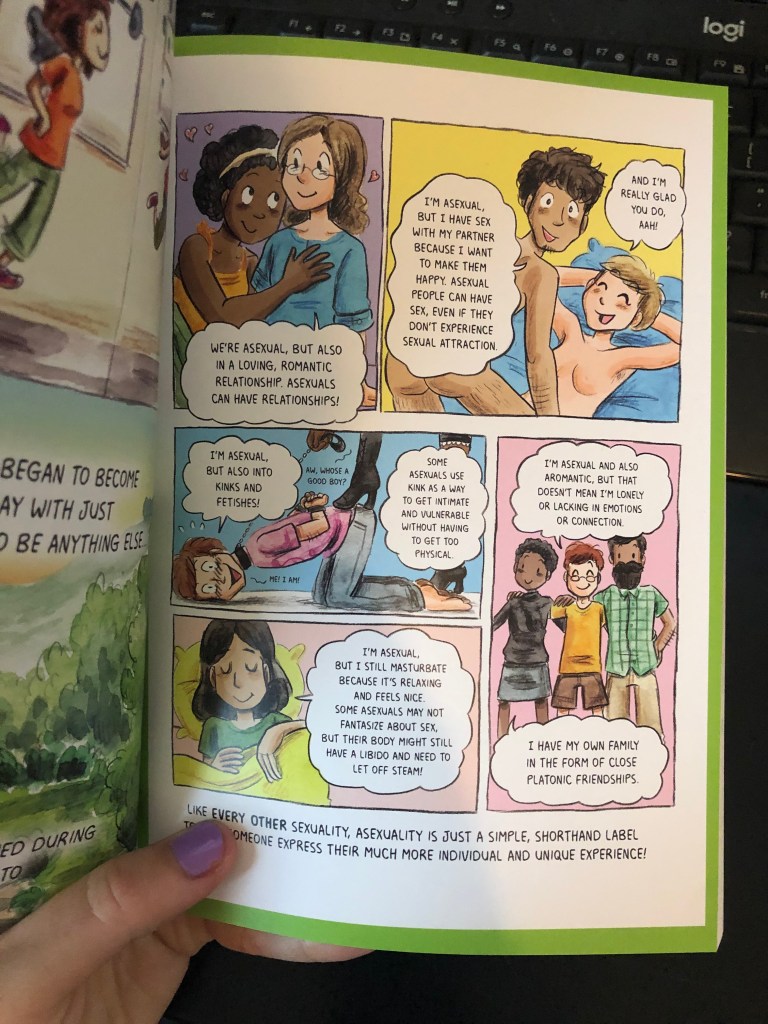
Burgess’s story would be good for people who want to learn more about asexuality and for those who want to feel less alone in their ace identity. The little informative pages at the end of each chapter reminded me of the asides and definitions in Jackson Bird’s memoir Sorted in that you could skip them if you already knew the info, but they were there if you needed them to learn more. Plus, the illustrations are so soft and comfortable that it truly feels like Burgess is inviting you in and bringing you a mug of hot chocolate to drink while she tells you her story by a crackling fire.
Now I just need more ace masc people and ace trans people to show up in the stories I read (or maybe those are the stories I need to write)!
Now, swinging back on the pendulum (this month was really a rollercoaster of mediocre reads punctuated by ones I related to hardcore), Make Time did not really give me a whole lot of advice that I found myself amenable to. To be fair, I probably shouldn’t have read this after a book satirizing the self-care industry, but alas, this book was meh.
The writers make a lot of assumptions about their audience, like that they’re neurotypical. Or have financial flexibility. Or do not live with disabilities. There’s also a pervasive use of “him or her” and “her or him,” which without exception gets on my frickin’ nerves.
I can see how this book could be helpful, and it’s nice that both authors have insights on technology from their time in Silicon Valley, but a lot of these tactics I either already do (at least sometimes), have tried before but didn’t work for me, or were things I would love to do but sometimes can’t because mental illness drains a lot of energy. That being said, some tactics I might use. Like reorganizing my phone apps and deleting a few, or making more time for like ten minutes of just moving around every day (which I already knew I needed to do).
The tone is very conversational and the authors do their best to make things as simple as they can. This advice is by no means bad advice (and actually is often good and well-intentioned), but I am a cynical person with multiple chronic illnesses and anxiety, and this book was not written for people like me. For someone who is looking to be more mindful of how they spend their time and has the mental capacity to do so, this is the book for you!
The Girl from the Sea is a cute queer love story between a selkie (which is kind of like a mermaid except they are akin to sea lions) and a closeted girl on an island. I do plan to re-read this in the future in full color because the ARC was mostly black and white, but it was still cute and whimsical and fun, as Molly Knox Ostertag’s stories usually are! I wanted something fairly uncomplicated, and that’s what I got. Sometimes you just need a story in which everything ends up okay (especially after a month of serious books).
I don’t have much to say about All the Places in Between. It was very clever in that there were practically no words and it was very meta, not shying away from the fact that this is a graphic novel, on paper, following certain formatting standards. The art style is sometimes hard to “read” and the narrative confused me, but it is a beautiful idea and explores mental health in a way I’ve never seen before.

Last and smallest, but not least, is the book from the Pocket Change Collective series, Concrete Kids. This is a poetry-esque, genre-defying small book that explores Amyra León’s experiences with race, foster care, daughterhood, and tragedy. This book is beautiful and insightful and heartbreaking and empowering. I find it hard to review anything akin to poetry, especially when it discusses experiences I’m not familiar with, so I’ll keep it short. I love this Pocket Change series because though the books are small, they really pack a punch. This one is no exception, and in fact has the most innovative format of all the ones I’ve read. Delightfully creative.
In complete defiance of the general seriousness of my reads in July, I’m starting off August with a queer fencing romance based on a light-hearted graphic novel series (Striking Distance by Sarah Rees Brennan). My brain needs a break, so I’m giving it what it needs. Hopefully, I’ll have enough brainpower to return to the Inside reading list soon, but until then, I’m going to happily stay in YA-land!
Good luck to everyone going back to school this month (teachers, students, school staff, etc.)! The world is still weird, education is still weird, but hopefully you can find some meaning and joy in getting back at it.
 As Cool As Mint Ice Cream
What a GREAT post!
LikeLike