
Silence is a fortress, a means of defense, a retreat from the confusing world of multiculturalism.
In Min-zhan Lu’s article “From Silence to Words: Writing as Struggle,” she explains the consequences of living between two different worlds. She spoke English with her parents at home, and Standard Chinese at school. Lu grew up during the Communist Revolution in China and realized that her English-
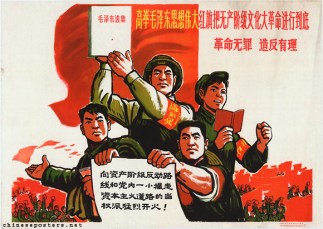
Propaganda from the Cultural Revolution under Mao Zedong in China (If interested, SparkNotes has a great rundown of the Communist Manifesto)
speaking was looked at as a revolutionary act outside of the house, rather than a means of success.
In the socialist society, “reading and writing were taught through memorization and imitation also encouraged me to reduce concepts and ideas to simple definitions” (Lu 441). She learned a political language, one intrinsically tied to the ideas disseminated by the government. Standard Chinese became the language of a loyal “Worker,” yet English became one of expression and emotion.
However, Lu’s story really stuck with me because she was not only unable to keep the languages separate, she was unable to keep the identities of the two separate. She developed an uncertainty in her handling of the languages. “…my reading and writing in the ‘language’ of either home or school could not be free of the interference of the other” (Lu 443).
This was something that I had never thought about before. Reading about bilingualism opened my eyes to the fact that bilinguals choose from one language repertoire, not two separate ones. However, Lu’s article made me realize that languages can hold different connotations in one’s mind. The way a language is taught can affect how one uses the language and thinks in the language. Lu struggled because she found her “English ideas” blending with her “Standard Chinese ideas,” which made her doubt her own thoughts, especially because the two languages have such differing ideologies.
This idea that reading and writing can be such a struggle, that one has to make difficult choices while using language. Because I live in a place with relatively  free speech, I have never had to worry about government or class-related backlash to what I write. I can express my own opinions, not just the ones my government and teachers wanted to hear. Knowing that language can be such a source of confused identity made me appreciate my own, relatively easy relationship with my language.
Lu fell silent for much of her childhood, but was eventually able to see the benefits of growing up within a world split in half. “For it was this complexity that kept me from losing sight of the effort and choice involved in reading or writing with and through a discourse” (Lu 447). Language is a gift, but it is not one that always comes easily.
Richard Rodriguez tells a similar story about his own childhood, but the identity crisis was more related to his educational experience. He felt he had to “keep separate the two very different worlds of my day” (Rodriguez 194). He describes himself as a “scholarship boy,” one that “must move between environments, his home and the classroom, which are at cultural extremes, opposed” (Rodriguez 196).

Rodriguez began to feel more at home among his books and teachers than his own family.
Again, I had never thought about the consequences of living in two extremely different cultures all in one day. Navigating between a relaxed, noisy home life and the strict, regulated side of school could not have been easy. This even caused Rodriguez to develop shame for his family’s “uneducated” actions and praise for his teachers habits. “I heard my father speak to my teacher and felt ashamed of his labored, accented words. Then guilty for the shame. I felt such contrary feelings” (Rodriguez 200). Because of this shame, he drifted apart from his parents in order to pursue an education.
Rodriguez also retreated into a silence with his family, barely talking to them and delving into books. He turned into a “great mimic; a collector of thoughts, not a thinker” (Rodriguez 203).
Unfortunately, both Rodriguez and Lu had trouble with their own opinions. Lu felt guilty for switching between two ideologies, and Rodriguez felt the need to copy other people’s thoughts. Language and culture clashing throughout one day can create a difficulty in forming one’s own opinions. Knowing this will help me a lot when working with multilingual writers if they request help brainstorming ideas. I will be able to encourage them and explain how they can use their language(s) as a tool for expression, not just a tool for survival.
Reconciling two cultures and languages can be extremely difficult. Because I have never had this struggle, I am glad that people like Lu and Rodriguez tell their stories. Learning about the personal consequences of multiculturalism has made me appreciate all the things that our multilingual writers go through every day. More and more throughout this semester of school, I have gained so much more respect for the students who have to navigate between two cultures and languages. It is something I have never had to deal with, and I
know now of some of the difficulties they face.
This is why telling stories can be so vital to the human experience, and why I will always keep my ears open to others’ stories.
Works Cited
Lu, Min-zhan. “From Silence to Words: Writing as Struggle.” College English, vol. 9, no. 4, 1987, pp. 437-448.
Rodriguez, Richard. “The Achievement of Desire.” pp. 194-206.
Pictures
https://chineseposters.net/themes/cultural-revolution-campaigns.php
https://posttraditionalbuddhism.com/2015/01/19/free-speech-and-buddhism/
http://www.pechakucha.org/presentations/third-culture-kids
https://www.steppingstones.com
 I’ll admit it: four years of high-school Spanish plus multiple years of grade-school Spanish have made me only passably able to understand and speak the language. This is partly my own fault, because I lost interest in learning the language late in high school, but it is partly the fault of my academic institutions. In her article about translanguaging, Ofelia García states, “…new language practices only emerge in interrelationship with old language practices” (3). Instead of using only Spanish to teach Spanish, my teachers should have let me draw from my own English repertoire in order to tie the two language practices together. García points out that practicing languages together allows students to “explicitly notice language features” (3).
 o focus on organization?
 ng the good parts was much more rewarding than correcting AP style mistakes or awkward sentences.
 No one has gotten very far without taking risks, and making students afraid to take risks will bleed into the rest of their lives. Pointing out the smallest errors will stick with a student for a long time.
 As I read more about writing center philosophy, I constantly come across clashing ideas—the editor vs. the tutor; peer tutors vs. authoritative tutors; nondirective vs. directive methods, etc. And most authors strongly pick one side or the other.
 expert by imitating or emulating the student. (Here’s a modern example of a
 What if I told you thinking is a social process? And knowledge is socially constructed?
 “Collaborative environments and tasks must demand collaboration. Students, tutors, teachers must really need one another to carry out common goals” (Lunsford 95). Group work is forced collaboration, which usually results in negative connotations of working with others. Lunsford argues that people must want and need to work with others on a certain task.
 and technology are everywhere. Professionals ask each other questions and work together! Offices and other workplaces are often set up to be social, collaborative places, so why aren’t classrooms set up this way? Computer programmers share their programs if they cannot figure out a glitch, writers get peers and professionals toedit their work, and rocket scientists solve difficult equations together, but two students who work on an assignment together will get disciplined for cheating. Working together constructively (without cheating or plagiarizing) is so, so important, but this lesson is often left out in the classroom.
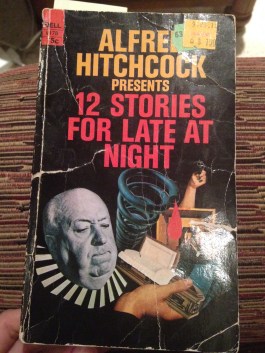 intelligent person, you would be right about that. The story actually starts with a tattered book from the dollar section of a used book store. Because my dad had previously mentioned he was somewhat of a Hitchcock fan, I decided to read Alfred Hitchcock Presents 12 Stories for Late at Night with my dad. As we read, we got into the habit of making fun of these outdated, not-so-horrific horror stories. With tales about a boy who pins butterflies to his wall and mannequins with creepy back stories, we certainly didn’t run out of jokes to make.
 As Cool As Mint Ice Cream