
What I Read:
- An Absolutely Remarkable Thing by Hank Green
- A Study in Scarlet (re-read) by Sir Arthur Conan Doyle
- The Story of Green Day by Doug Small
- Winesburg, Ohio by Sherwood Anderson
- Part of The Courtier by Baldesar Castiglione
- Mrs. Dalloway (re-read) by Virginia Woolf
- All Out: The No-Longer-Secret Stories of Queer Teens throughout the Ages edited by Saundra Mitchell
- King Lear by William Shakespeare
- Some local zines
- An Alternative Press magazine from Sept. 2018
- Flatmates by Marion Wood (fan fiction)
What I Bought:
- Wild Beauty by Anna-Marie McLemore
- All Out
- The Story of Green Day
- Shenanagins by Green Day (CD)
- Local zines/chapbooks
Instead of doing normal book reviews, I’ve decided to take a Polysyllabic Spree approach to each month. The Polysyllabic Spree is a series of essays from a column Nick Hornby wrote from September 2003 to November 2004. He listed “Books Bought” and “Books Read” for every month, and then discussed similarities/differences, his life, or anything at all that remotely had to do with what and the amount he read that month. I’m going to try to do something similar, because I loved those essays so much!
To start, let me explain why I’m not calling my lists “Books Bought/Read,” but rather more vague titles. Last month and this month, I’ve been watching a lot of BookTube (videos on YouTube about books), and on my sister’s recommendation, I began watching Ariel Bissett’s videos. She is a lovely Canadian writer, reader, editor, and lover of all things written word. To sum up my experience watching her videos: she has rocked my world when it comes to the way I approach reading. She has a lovely video about how people don’t read things they can’t track, and I realized I was one of those people! I realized I was treating reading like something to check off a list, something to get done as fast as possible, instead of savoring whatever I was reading. She inspired me to read more than just books—zines, magazines, fan fiction, blogs, etc. I don’t want to be stuck just reading books if there are other wonderful words out there that are just not in book form.
That’s why my list this month is pretty eclectic. While most of the list is still books, I have actually read so much more not in book form than I did probably all of last year (not counting schoolwork). I went out and bought a bunch of local zines from a local bookstore (buy local!) and I spent an entire day reading them, listening to music, and poring over their beauty and uniqueness. I kind of want to make my own zine, now… We shall see if that ever happens.
The books King Lear, The Courtier, Mrs. Dalloway, and Winesburg, Ohio have been read for class; I am an English major in my second-to-last semester of undergrad, so I’m taking a weird assortment of classes, but the only two relevant here are my Renaissance Lit course and my 20th Century Lit course. These are two eras that I have learned are not my favorite when it comes to reading. The Renaissance era is a lot of very formal writing/speaking, and (in an unpopular English major opinion) I’m not a huge fan of Shakespeare. The same goes for Virginia Woolf—not a fan. Virginia Woolf and Shakespeare both contribute a lot to the English-language canon, but I just didn’t find myself enjoying these books very much.
Okay, let’s talk about Hank Green’s book. I’m late to the game (as usual), but I finally read this book after getting it for Christmas. I have to admit, at first, I wasn’t too enthralled with the story. I had high expectations because lots of BookTubers lauded this book so highly that I just knew it must be wonderful—but I didn’t click with it at first. It might have been because this book is about YouTube fame, or marginalized fame, and that is something BookTubers understand more than I do. Or it could just be that the story doesn’t pick up until about 100 pages in. I did thoroughly enjoy this book by the end of it, and the ending made me angry, curious, and confused all at once in the best way possible. I would still recommend this book, just with the caveat to stick with it even when it doesn’t seem too exciting at times.
The last two books I really want to discuss are the anthology All Out and The Story of Green Day. The anthology is one I discovered through BookTube, from another favorite of mine (Cece Ewing). She recommends lots of queer books, and many of them are #ownvoices! Woot woot! Anyways, this anthology has stories set all throughout history about queer characters. While not all of these short stories were the best thing I’ve ever read, they all hold a special place in my heart because of what they represent. My favorite story in the entire anthology was “And They Don’t Kiss at the End” by Nilah Magruder, which is about an asexual, black girl in the 1970s. It takes place on a roller-skating rink and includes my new favorite quote: “Kissing makes me laugh.” For context, I have only kissed one person ever, and I didn’t really enjoy the experience. So this quote made me laugh hysterically, and I even named the next playlist on my phone after this quote.
If you know me, then it is no secret that I LOVE Green Day. I often joke that my proudest moment is getting my dad to head-bang with me at a Green Day concert in Minneapolis (and half the time I’m not even joking). I have collected all of Green Day’s albums, and am now trying to collect compilation CDs that they’ve put out. But I was never able to find a book about Green Day until one fateful day at Half Price Books, when I looked in the music section, and I found Billie Joe Armstrong, Tre Cool, and Mike Dirnt staring back at me. It was fate.
While this book only reaches until 2005, I learned a lot and have so much more respect for this band than I already did. I love reading about music scenes or bands, and this book definitely made the list of best books I’ve read about music (right behind Meet Me in the Bathroom by Lizzy Goodman, about the early 2000s New York City rock scene).
I suspect February will be a slower reading month, because I am not on break for even part of the month, and I turn 21 so that weekend probably won’t involve too much reading. But January was a good month. I’ve re-learned to relax and enjoy reading in whatever form it comes to me in—even if that form is fan fiction about Sherlock Holmes and Hermione Granger.

 good at, because I thought it was stupid to be proud of being good at a Wii game. This time around, it only took me one song on the easy level to get back into my groove, and we were off. Not only did I get to do something I was good at, I also got to listen to fun music, sing along, and hang out with my dad and sister.
 Point, but Rock Band doesn’t have a Point. Reading doesn’t always have a Point, either. Even writing and playing guitar only have a Point if I give them one.
 good at playing it, even though it is fun and I am proud that I made it this far. “This far” is pretty much only the basics, but it’s still more than a lot of people can do.
 would figure out my friends had visited her after the fact. But I could have asked to be let in on the plans. I could have gone on my own. Really, the idea of visiting her in the hospital made me nervous, because, though I know that my friend has a chronic illness, it was still hard to believe that she could be suffering so much.
 emotions. I met my friend’s parents for the first time, and when we went into her hospital room, it was dark and she was in so much pain she could barely speak to us. So the person who drove and I sat in two chairs (mine being the more uncomfortable of the two) and spent time with my friend. Some moments, she was the good old funny girl I came to be friends with, and some moments during we just sat in silence with soft music playing in the background.
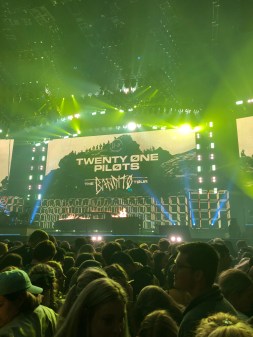 and even after getting back at two in the morning and barely sleeping, I tried not to let myself feel it. As we all know, that never works for long.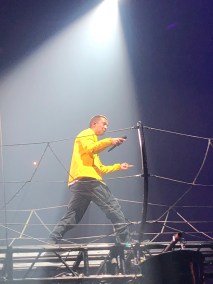
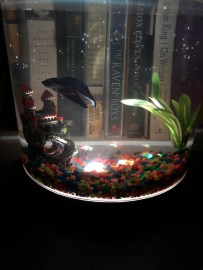
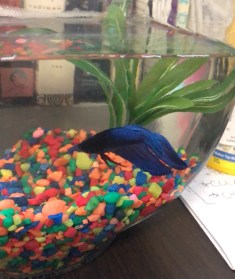
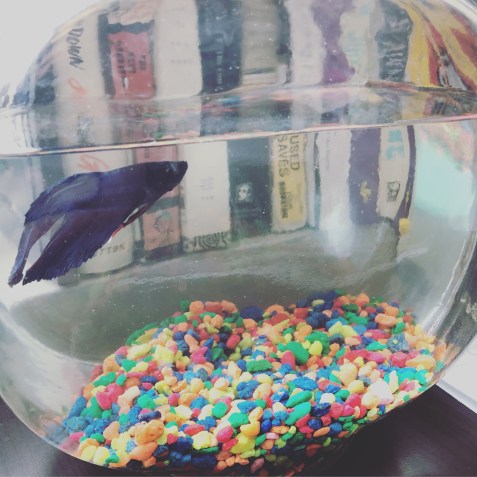
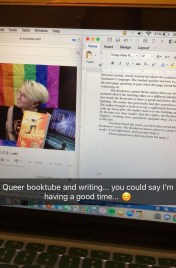 time in cleaning Chester’s old tank and decorations, letting myself go through the grief as slowly as I needed to, ignoring the guilt over putting so much thought into a fish’s death.




 though someone else had.
 every person embodies—which is the best kind of book.
 Gay reminded me that I should allow myself both sadness and happiness in one space, because we all contain contradictory identities that somehow all make sense. We need to allow space for everything, the weaknesses and the strengths, without sugarcoating or denying them. Gay’s sincere honesty is a rare gift, one not often found even in the most eloquent of writers. I will cherish that gift, because it came at a time that I still felt like I needed to apologize for certain aspects of my existence.





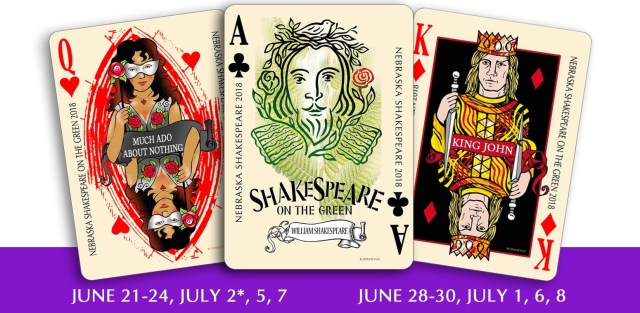


 performed through his injury, but also used it to make the play even better. (And, I have to admit, he looked just as suave with a cane as without it. That takes skill!)
 As Cool As Mint Ice Cream