
What I Got:
- Lost Boi by Sassafras Lowrey
- The Girl Who Became a Beatle by Greg Taylor
- Vogue Dec. 2020
What I Read:
- King of Scars (reread) by Leigh Bardugo
- The Magic Fish by Trung Le Nguyen
- Rule of Wolves by Leigh Bardugo
- The Times I Knew I Was Gay by Eleanor Crewes
- Ophie’s Ghosts (ARC) by Justina Ireland
- The Devil All the Time by Donald Ray Pollock
- Séance Tea Party by Reimena Yee
- Sheets (reread) by Brenna Thummler
- Delicates by Brenna Thummler
- Plain Bad Heroines by Emily M. Danforth & illustrated by Sara Lutman
As I noted last month, September was the first Magical Readathon: Orilium—The Novice Path. I was actually able to exceed my expectations for my planned TBR, which felt awesome! For the books that I read for the readathon, the words in parentheses after the titles below are the readathon prompts that each book counted for.
This is a long one, friends, so buckle your seatbelts and get ready for the ride!

King of Scars (has a map) is one book in the Nikolai duology that continues the stories of some characters in Leigh Bardugo’s Grishaverse. I love the Six of Crows duology, but not so much the original trilogy, so when I read this for the first time, I was hesitant. I was upset that a major plot point had been reversed (which is a bit hypocritical of me, because I like Marvel movies…). This time through, I decided to get over that prejudice and see if I could enjoy it more. And despite the fact that I bumped down my rating half a star (for the inconsistencies in plot and pacing), I actually did enjoy this book more the second time around.
It’s a good thing I got over that major plot point reversal, because there were quite a few reversals going into Rule of Wolves (5-star prediction). Still, I loved this book! A few favorite Six of Crows characters made cameos—little glimpses into the futures they’d carved out for themselves after we left their stories. Plus, Nina’s storyline picked up the pace a little bit. Her storyline dragged quite a bit in King of Scars, but it became more important and intense in this second book.
In this sequel, Bardugo really hammers home the humanity and complexity of every character, even though quite a few of them toe the line between human and “monster.”
I’ll admit that the parts about war and politics weren’t my favorite (just personal preference), but everything comes together in an unexpected but entirely believable way. The main gripe I have with this book is that one character death felt unnecessary. It didn’t add to the plot nor was it needed for character development. However, the romances in this book were important to the plot and the characters rather than just added in for no reason.
There is trans rep in this book, too, which was unexpected but delightful. Not gonna lie, the mostly happy ending for the queer characters almost made me cry. Leigh Bardugo has once again played with my heartstrings like an eight-stringed khatuur.
It’s no secret that I love stories about ghosts. Enter Ophie’s Ghosts (features ghosts, haunted house, or other supernatural elements) by Justina Ireland. This story has so much depth and heart to it. It’s often heartbreaking, but Ophie’s strong spirit (pun intended) makes this a fun book to read. Like many of her women ancestors, Ophie can see ghosts. With this comes the responsibility to help ghosts cross over, though Ophie pushes the boundaries more than her aunt recommends.
To tell the story, Ireland uses little interludes from the perspective of certain locations, which were very creative, but sometimes felt unnecessary. Other times they added to the story’s atmosphere, though not often to the plot. The plot is kinda slow, but I didn’t mind that so much. The characters aren’t always well-rounded, although I do love how persistent Ophie is in her quest to help the ghosts trapped in the house she works in. Even if they scare her or actively work against her, she still wants to help them move on from this world.
This book deals with lots of important racism-related topics in an imaginative way, as well as covering how grief affects everyone differently. I haven’t read a lot of novels about Black history that take place during the Roaring ’20s. Most books set in the 1920s that I’ve read are all about the American Dream and wealth and opulence a la The Great Gatsby. This perspective of the 1920s is definitely one that needs more attention, because a lot of that opulence was built on the backs of people like Ophie’s family.
In the same ghostly vein, I managed to read three graphic novels about ghosts, too. I think I forgot that it wasn’t October yet. Oh, well, ghost books are good any month of the year.
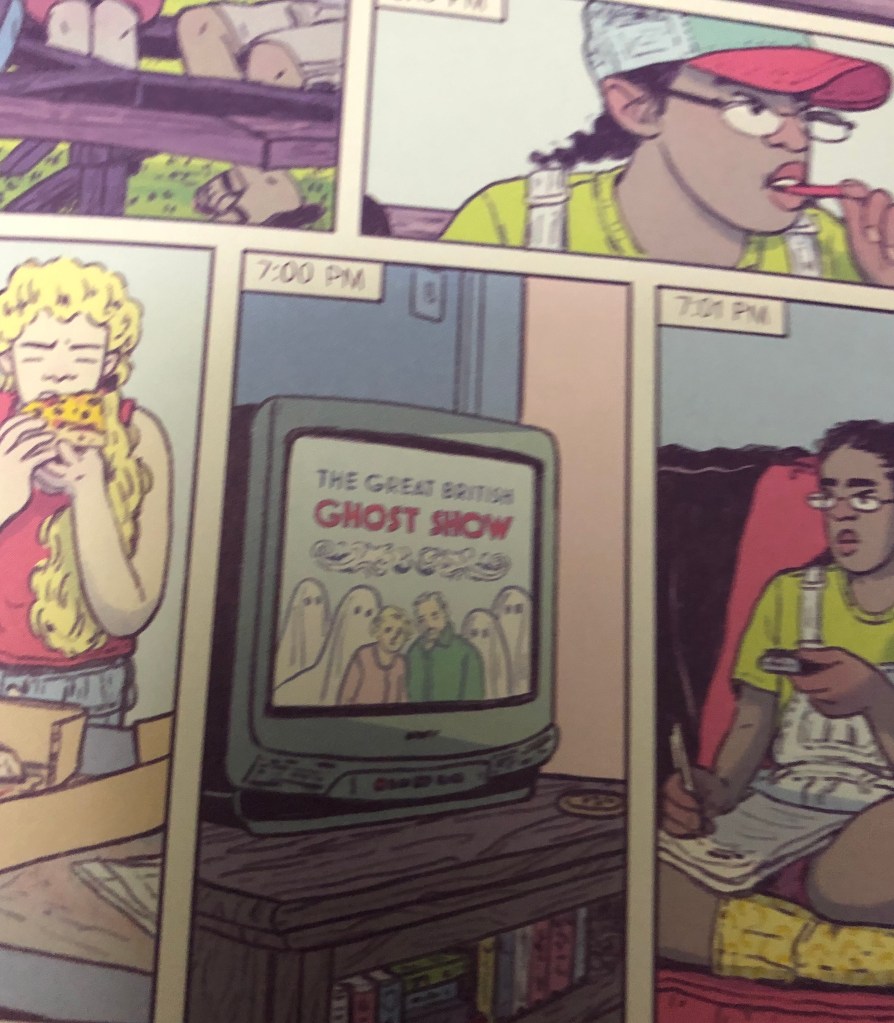
I reread Sheets to refresh my memory for the sequel, Delicates (school setting). Though Brenna Thummler’s illustration style isn’t my favorite, these two books are still so emotional. The new main character in Delicates was a great addition to the story, and because she is a paranormal photographer, her role doesn’t feel forced. Though the “I want to belong so I’m ignoring my moral compass and hanging out with the popular mean girls” trope didn’t do much except set the precedent that Marjorie doesn’t stand up for anyone. Including herself. Of course, by the end, she is redeemed by befriending the person she’s hurt and doing more to validate their experiences. I really did feel like Marjorie tried to be better, but it took her too long to get there for me to be super happy about everyone forgiving her so fast.
These books manage to be both cute and heavy, dealing with a lot of serious topics such as parental death, suicidal ideation, mental health issues, bullying, child death, and other themes on this track. So make sure you know what you’re getting into before reading these books.
The other spirit-filled (in both senses of the word) graphic novel I read was Séance Tea Party (keeps tempting you/top of TBR) by Reimena Yee. Happily, I can one hundred percent say that this book is on my ever-growing list of delightfully queer and supernatural middle grade graphic novels that I love. (I’m aware that this is a very specific set of criteria for a list, but these are just a perfect blend for me.)
I have to admit that I wish there were more focus on the seance tea party aspect of the story; it’s just the instigator of the story itself. Lora is a fan of all things spooky and is worried that growing up means leaving these things behind. Feeling like her friends have moved on without her, Lora rediscovers her imaginary friend, the ghost Alexa.
This story about how growing up doesn’t have to be a big deal. You don’t lose your imagination or the things that make you unique. It’s about how having a life ahead of you is a gift because you can still be anyone you want to be, even if that person is just an older version of who you already know you are. You can love weird shit forever, not just as a kid. Not a lot of middle grade books explore this theme. They’re usually just about finding who you are now, rather than the idea that who you are can evolve purposefully and that “growing up” isn’t a before and after, it’s a continual experience.
The illustrations are fun and have a unique style that really fits with the narrative—whimsical, magical, and witchy. I loved all the little creatures in the white space that ended up being an actual part of the story.
The other two graphic novels on the list this month are very different from the three preceding titles.

Wow, was The Magic Fish (standalone) by Trung Le Nguyen amazing! The art was stunning. I particularly loved that, for every character with long hair, their hair seemed to have a life of its own. Lots of intricate linework. And the colors make the story feel full and help differentiate between the past, present, and fairy tales. This is a book about communication, first and foremost. The main character doesn’t have the words to tell his mother he is gay, because he speaks mostly English and she speaks mostly Vietnamese. They connect through fairytales.
I loved reading the extra notes at the end, too, explaining how Nguyen wanted the illustrations to mirror the experiences of the characters. He expressed his desire to tell a small story surrounding immigration rather than a broader story, and his discussion of hybrid languages is really beautiful. It made me appreciate the way the text and art work together as a whole, interacting with each other in an engaging way. They’re complex but not hard to read on the page. It’s clear that these illustrations have so much heart and hard work in them.
This is an immigration story and a queer story, but it’s also so much more. It covers such a small slice of life but it feels so big. (Plus, I love a good take on The Little Mermaid, my favorite fairytale.)
The Times I Knew I Was Gay (contemporary fiction or nonfiction) by Eleanor Crewes is exactly what it sounds like: the story of a person’s epiphany moments in regards to their sexuality. Every time I go into a queer story, I think, “This one won’t make me as emotional as the last one,” and I’m always wrong. The story and drawings in this book are simple, but the simplicity works. It makes the idea of exploring your sexuality and coming out feel a little simpler, too.
Now onto the slightly disappointing reads of the month. Apparently I want to end this post on a downer… Oops.
The Devil All the Time (thriller or mystery) wasn’t so much disappointing because I had super high hopes for it; I actually only read it to watch the movie with Tom Holland in it. The book was disappointing in its gratuitous sexism/racism/homophobia/general discrimination. It was almost like the author decided on the 1960s-70s setting just so he could use slurs and insensitive language. It’s not endearingly retro to read hate speech if that’s what he was going for. Nor does it add to the “accuracy” of the story, especially when there’s so much of it and with no real point.
I will admit that it does become a page-turner in about the last third because everything comes to a head. But after the climax, the ending is both lackluster and predictable. I don’t read a lot of thrillers, but I can tell a poorly written book when I read one. I’m not even really sure how to explain the plot of this book—religion, murder, and a small town?
Because there are too many main characters, you don’t ever invest in them or feel much emotion around their deaths. Even if that emotion is just supposed to be horror or disgust. As further proof of the book’s misogyny, every woman was just there to further the plot for the men—as a mother, tragic death, or blind follower.
Despite the book being horrible, I did end up watching the movie anyway. I put in all that effort to finish the book—I wanted Tom Holland!
The movie was well done cinematically speaking, but it still had the same problems as the book (minus the actual slurs). It doesn’t pass the Bechdel test, obviously, and I’m not sure I actually would have understood what was going on if I hadn’t read the book.
I think it’s interesting that the book is framed as a rural thriller with a strange cast of characters, whereas the movie is framed as a thriller about a young man trying to protect the people he loves. I find that the book description is more accurate.
In the movie, there was practically no reason for the Roy and Theodore timeline to even be there. It added so little. It’s true that their spidery sermon is the catalyst for many of the characters’ stories, but they didn’t need to be there after that point.
The place this movie shines is in the acting. There are so many non-American people in this movie who do the rural Southern accent eerily well. Robert Pattinson’s voice sounded so sleazy it made me hate the character even more. He sounds like a completely different person. Bill Skarsgård had another one of the better performances in this movie, but unfortunately his character dies super early on.
I’m really not sure why they decided to make a movie out of this book in the 2020s, and I’m not sure how they got such a star-studded cast, but it’s there, I guess. That’s all I can say.
In Plain Bad Heroines (dark academia), Emily M. Danforth tells the story of a book. A book that causes scandal and maybe even a curse. This is also the story of queer women in the early 1900s, a school for girls, and a modern-day movie being made about them.
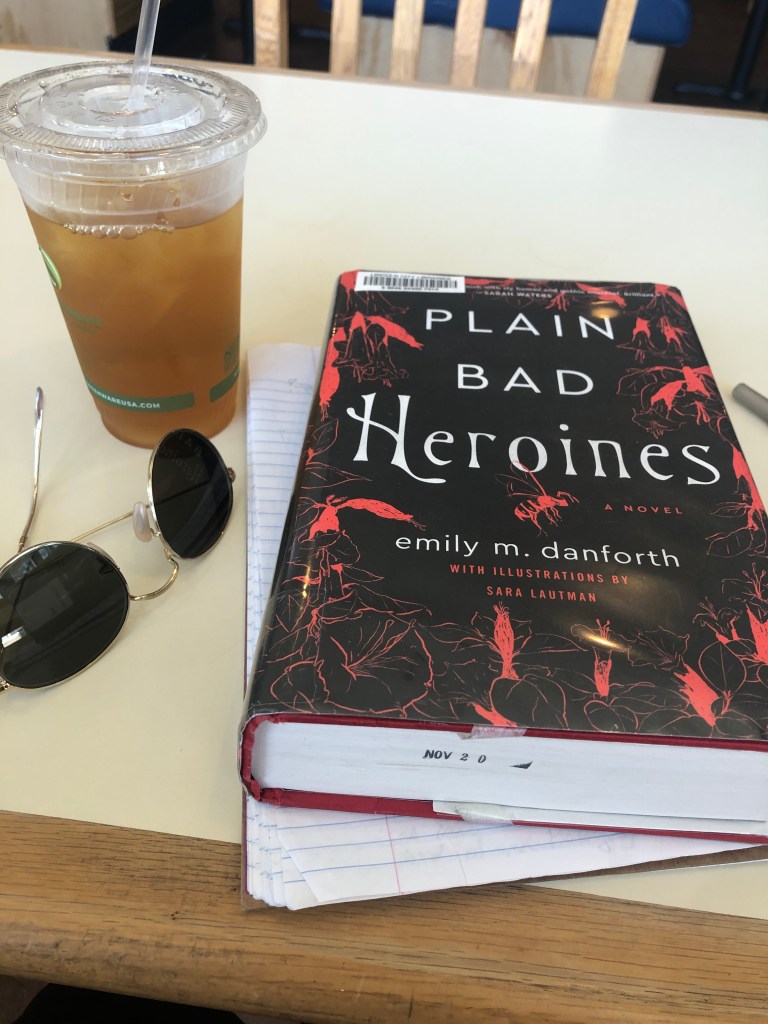
This book was disappointing partially because I hyped it up a lot, and partially because only parts of it had a dark academia atmosphere. It might technically be dark academia, but it loses points for not feeling like dark academia. It has many elements I like and is also by the author of The Miseducation of Cameron Post, which is a top-notch book. I thought it was going to be awesome and brilliant, but it ended up being only a couple steps above average.
Danforth uses two narrative devices that I usually like. One is the use of footnotes. I love when stories use footnotes, and this is a great example of how to (mostly) use them effectively. True to what footnotes should be, they definitely add to the story, but most of them aren’t essential to the story. Though there were a few that, if left unread, might leave some things more confusing than they already are. Sometimes, the footnotes would just confirm something that the characters themselves didn’t know was true or not. Sometimes they would add extra info, allowing you deeper into the story’s world.
The other device was direct address (when the author addresses the reader(s)). This, unfortunately, felt gimmicky. Especially with all the comments like, “you’ve probably already seen this,” followed immediately by explanations. If in this world it’s something I’ve already seen, why address it like that? It takes you out of the world, not just the story. This device is supposed to take you out of the main story, but not the whole world created in the book.
This book is another dark(ish) academia story that includes flying, stinging insects; books and bees seem to be a common pair in this genre. While The Starless Sea and The Raven Cycle may have made me appreciate bees a bit more, I can’t say I’m a fan of yellow jackets now. (Yellow jackets the wasps, not the clothing. I could rock a yellow jacket.) In fact, I might find them scarier than before.
The yellow jackets in this book play a role in quite a few characters’ deaths, which I found the most terrifying of all the things that were supposed to be terrifying. Any book with wasp-related deaths fits in the horror genre for me, but the rest of the plot wasn’t always super horrifying. Mostly just disgusting or confusing.

Overall, the book was a bit slow and not really that scary. It was super meta, which might be why the horror element wasn’t so strong. We also don’t get to see enough of how the three current-day main characters became close and then not close and then close again. There was a lot of language like, “it just was that way” or “they were all feeling it” and not a lot of buildup to getting there, especially when Merritt’s distaste for Audrey made a random 180.
All that being said, this story has so much skill in its complexity and woven narratives. The descriptions are beautiful. Even as someone who doesn’t actually play a movie in their head when they read, I could really see the settings. And like in Ophie’s Ghosts, the main setting acts as a character, so it was important to feel immersed.
Doing a readathon this month gave me a sense of purpose that I sorely needed. I’m still unemployed, and it’s often difficult to fill my days with activities that feel purposeful and important. I know I am hard on myself about using my time, but lately my days have felt dull because of my lack of direction. Setting myself a challenge motivated me to do more of something I love—reading—and gave me an alternative to sitting around feeling bad that I’m not applying for jobs every free second of the day.
The Magical Readathon was, not to overdo it, magical in more ways than one. It pushed me to read outside of my comfort zone (even if that book wasn’t a success) and renewed my ability to find purpose in simple days. Like I said, magical!

Postscript
I made a trip to the Raven Book Store in Lawrence, Kansas, this month and it was awesome! Such a diverse collection of books and everyone was welcoming and kind. I’ve been searching for Lost Boi by Sassafras Lowrey for years because it’s a bit of a niche queer book, and the fact that I found it at the Raven says a lot about the thought they put into their inventory. If you’re ever in the area, I would definitely recommend stopping by.
If you’re still not convinced, it’s on Mass Street, which has a bunch of cool local businesses like La Prima Tazza (café) and Love Sound Gardens (CDs/LPs). Also, several people said hello to me and asked me how I was doing, and even though I’m not usually a fan of speaking to strangers, I have been missing that Midwest niceness lately.
 As Cool As Mint Ice Cream