
What I Got:
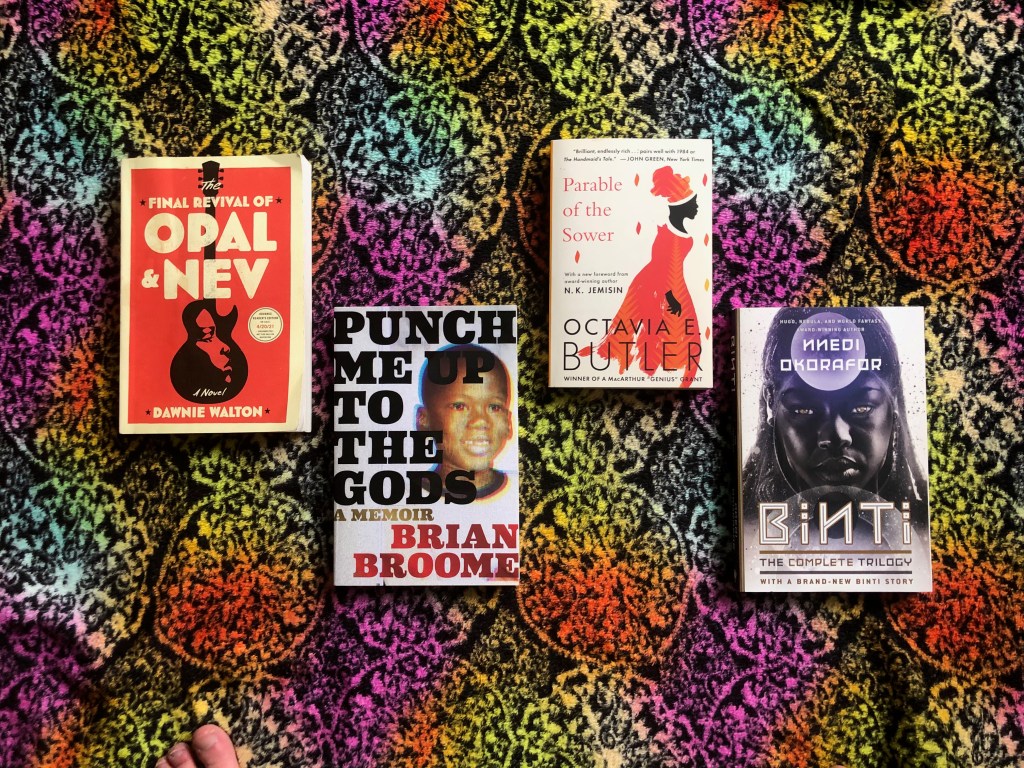
- Punch Me Up to the Gods (ARC) by Brian Broome
- The Nickel Boys by Colson Whitehead
- Everyone in this Room Will Someday Be Dead (ARC) by Emily Austin
- On the Books by Greg Farrell
- Out of the Basement by David A. Ensminger
- Monday’s Not Coming by Tiffany D. Jackson
- Out of the Woods (ARC) by Luke Turner
- The Crash Palace by Andrew Wedderburn
- Baby by Annaleese Jochems
- Permission by Saskia Vogel
- Fauna by Christiane Vadnais
- The Other Black Girl (ARC) by Zakiya Dalila Harris
What I Read:
- You’ll Never Believe What Happened to Lacey by Amber Ruffin and Lacey Lamar
- A Study in Scarlet Women by Sherry Thomas
- The Nickel Boys by Colson Whitehead
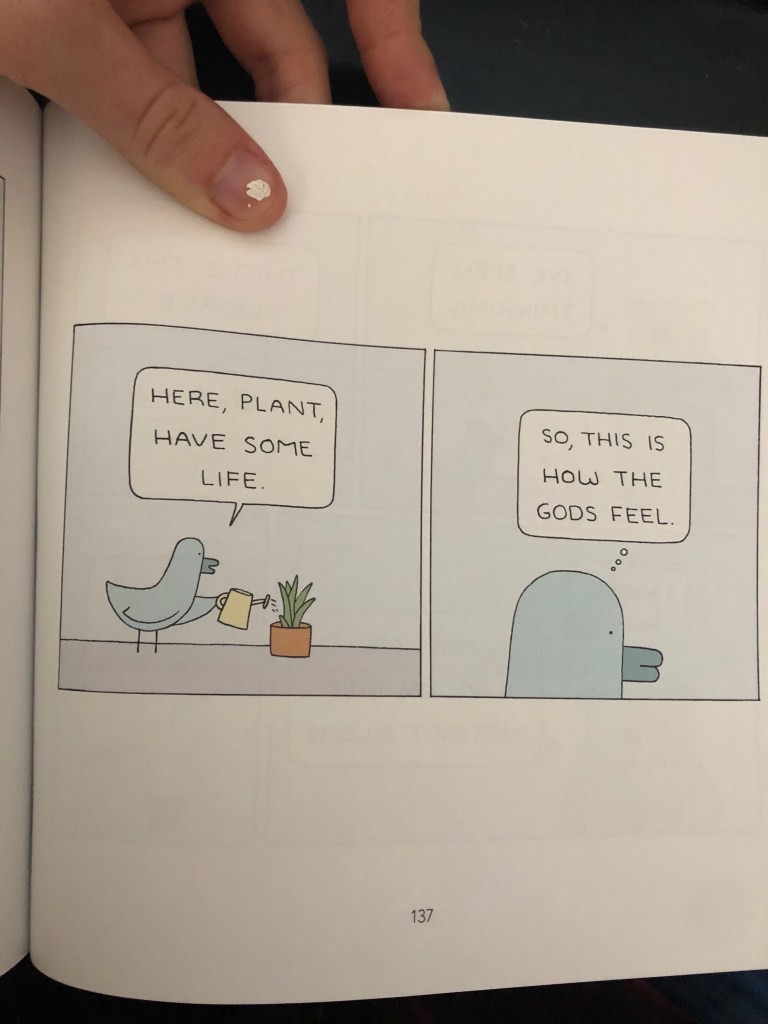
- Poorlier Drawn Lines by Reza Farazmand
- War Girls (old ARC) by Tochi Onyebuchi
- A Gift for a Ghost by Borja González
- Even If We Break (audiobook) by Marieke Nijkamp
- Started Take a Hint, Dani Brown by Talia Hibbert
Black History Month is at its end, but I want to take this opportunity to remind everyone that this is not the only month to learn and read about Black history and Black stories. Black history is important history, and Black stories are important stories. This is the month we focus more on those stories, but they don’t disappear after February.
Anyway, time to get off my soap box and step into my book fortress.
You might notice that this month’s list of books I’ve read is a bit shorter than the past months’ have been. This is because I decided to slow down with my reading. I was starting to feel emotionally detached from what I was reading because I was reading so many stories in such a small amount of time. The two aspects of reading I enjoy most—learning and empathizing—were becoming nonexistent in the face of a stupid competition with myself to check books off the list. I’ve still read a lot, but slowing down has made reading infinitely more enjoyable again. And now I can give more focus to the books in these reviews.
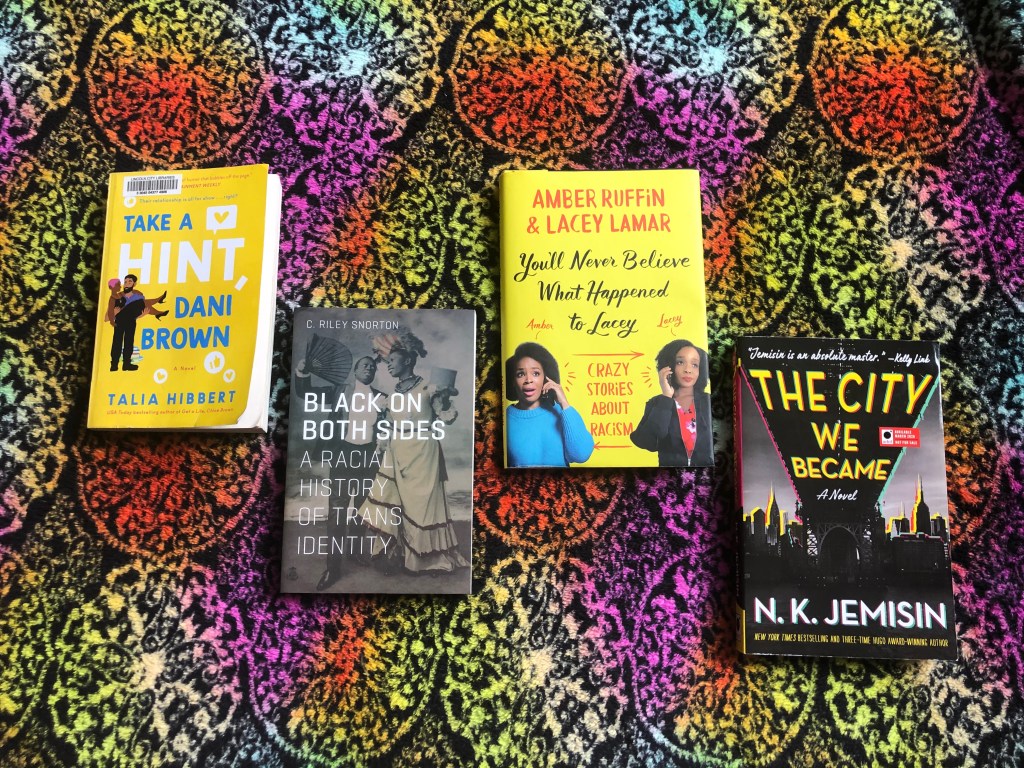
I first fell in love with Amber Ruffin’s humor in the segment “Jokes Seth Can’t Tell” on Late Night with Seth Meyers. One day, I binge-watched a ton of them and couldn’t stop laughing. Imagine my excitement when Amber Ruffin and her sister put out a book! The book is a funny yet honest look at the racism Lacey Lamar, who lives in Omaha, NE, has experienced on the daily for her entire life. It was eye-opening for me as a white person as it points out all sorts of racist attitudes and actions people let slide. It fired me up while making me laugh intermittently.
The fact that most of the stories happened in or near Omaha gave me valuable insight into the city I grew up in and that is still only an hour away from me. I knew Omaha is not the most progressive and a bit segregated, but it astounds me how blatantly racist people can be and the amount of microaggressions they don’t even think about. The only thing that I disliked about this book (besides the fact that people have been so horrible to the authors) was the conversational narration. The conversation seemed contrived a lot of the time, and it would distract me from what they were actually trying to say. Other than that, this book is wonderful and hilarious and valuable and I recommend it for all of that, along with its refusal to shy away from hard truths to make others more comfortable.
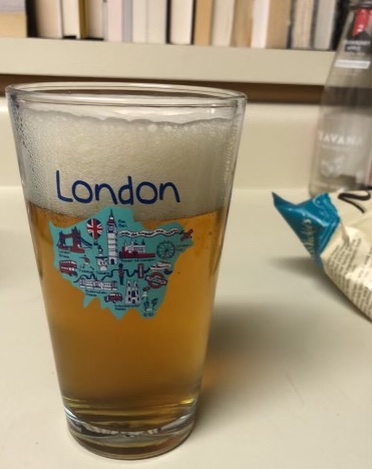
After that book, it was time to get away from Nebraska. London was the next stop on my sister’s traveling-through-books itinerary, which included watching BBC Sherlock and Mary Poppins, enjoying a “pint” with some salt and vinegar chips in place of fish and chips, an afternoon tea, virtual tours of The British Museum and The National Gallery, and the book A Study in Scarlet Women by Sherry Thomas. I’ve been a fan of Sherlock Holmes since I read the stories all the way through in eighth grade, and I’m picky about the Sherlock adaptations I continue with. A Study in Scarlet Women is the first in the Lady Sherlock series and was a pleasant surprise. It certainly wasn’t the best adaption of the character, but it was a unique and mostly well-written one. Unfortunately, Charlotte Holmes was like a watered down Sherlock in this first book. She makes quite a few emotional decisions, is motivated by things other than boredom/necessity, and of course there had to be a love interest. Ugh. I was not happy about that addition.
As the series progresses, I’m hoping that she acquires some of the weird skills that Sherlock has now that we’ve gotten the backstory out of the way. The plot was a bit lax at times because of the focus on Charlotte’s “scandal” and her subsequent creation of the false identity “Sherlock Holmes.” She does this in order to get taken seriously enough to make some money from her deduction skills. The actual mystery got pushed to the backburner a lot. Since this book did all of the setting up, I hope the next one will be more mystery-oriented. Because I do want to continue with this series and these characters. Charlotte is a strong woman who makes decisions to bring about the future she wants (like sleeping with someone solely so she’s undesirable for marriage and can pursue other paths), who cares so much for her sisters (one of whom writes out the mysteries, even though there is a separate character named Mrs. Watson, which confuses me a bit), and who embraces her intelligence in spite of judgment. Worth a second chance, wouldn’t you say?
My sister and I read The Nickel Boys by Colson Whitehead this month. Oh, boy, is this an emotionally difficult book to read. The fact that it’s based on the real-life Dozier School for Boys makes it all the more horrifying. Elwood has a promising future, supportive people in his life, and an almost naïve hope for the world. That is, until he has to hitchhike to some college classes and gets arrested because the man who’s driving stole the car. He gets sent to a “reformatory school” and endures horrors far beyond exhausting manual labor, such as debilitating corporal punishment, weeks-long solitary confinement, and threats of being “taken out back” (a.k.a. being tortured and then killed) if he alerts anyone of the goings on at the school. He makes friends with the pessimistic Turner, and they end up going through the months there together, trading viewpoints and looking out for each other.
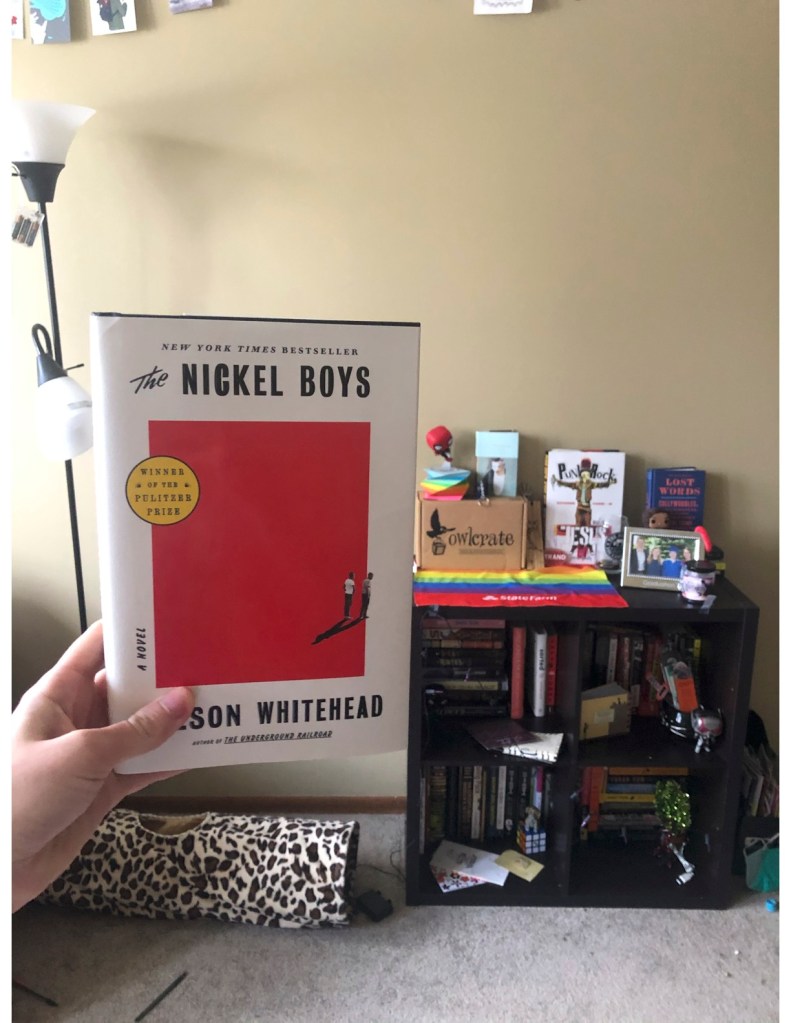
Elwood had such a bright future and pretty much everything going for him, except for the fact that he was a Black person in the U.S. He was in the wrong place at the wrong time, and because the “justice” system is inconsistent and racist, he gets punished for that. No warnings or second chances or opportunities to explain.
There is one scene that tore my sister and me to shreds. After Elwood gets beaten for the first time, his legs are absolutely shredded and take a long time to heal. After they are healed, his grandmother comes to visit. All he wants to do is tell her what happened to his legs. Tell her what they did to him. Show her the scars. But he doesn’t, because he’s ashamed. And he’s scared. He gets this beating for trying to break up a fight. Yet his kindness doesn’t disappear after this. The school breaks him, but it doesn’t take away all of that kindness.
Don’t go into this book without knowing that it is a difficult read. I’ll probably miss some content warnings, but this book deals with racism, rape, torture, corporal punishment, beatings and fights, brutal deaths, injuries, corrupt leadership, absent parents, alcohol abuse, physical labor as punishment, use of the n word, and probably more that I’m missing. Having said all this, the writing is incredible and effective, the history is important to acknowledge, and the characters are fully fleshed humans. I heard Colson Whitehead speak in a panel titled “Novelist as Citizen,” and he made the comment that he doesn’t make any group of people all the way evil or all the way good; Black people aren’t the enemy nor are white people, because both can be corrupt and horrible and hopeful and kind and a thousand other things.
Instead of taking a break from heavy books to give my emotions a break, I decided to watch the Netflix documentary 13th (based on The New Jim Crow by Michelle Alexander) and pick up the book War Girls, which is a futuristic take on the Nigerian civil war that took place in the late 1960s. This book wasn’t as compelling as The Nickel Boys, though I am grateful for the focus on African history and the education I got from reading the story. The futuristic aspects added a lot to the story, especially with the concept of the abd, or slaves that are basically patchwork young boys with augmented brains trained to fulfill only the objectives of their “sisters.” I also enjoyed how the androids, Augments, and abd complicated the idea that it’s easy, even necessary sometimes, to see others as nonhuman during a war.
Onyii and Ify are sisters, sort of. Onyii was a child soldier (for the Biafrans) who found and rescued Ify (a light-skinned Nigerian) and took her to the War Girls camp, which is basically a refugee camp for displaced girls. When the camp gets raided and the sisters separated onto different sides of the war, the dehumanization of the enemy gets further complicated. With the Western colonies literally being removed from the planet where the war is taking place but selling weapons to one side anyway, Tochi Onyebuchi was able to exacerbate the fucked-upness of the Western world’s tendency to further wars for their own gain at the expense of thousands (or millions) of lives.
The writing style wasn’t my favorite and the plot had sections that lagged or were repetitive. It was sometimes too easy to see what was going on with the characters, if that makes any sense. It was too clear to see what the author was trying to do before it happened. This is coming from someone who is usually horrible at predicting stories. The one thing that Onyebuchi did well, though, he did perfectly: using the book’s genre to add more depth to the story.
Speaking of predicting stories, I was actually able to predict the culprit in Even If We Break, which surprised me thoroughly! YA thrillers are the only thrillers I usually enjoy, and this one was no exception, especially with all of its wonderful representation (although a lack of racial and ethnic representation was gapingly obvious though addressed in the book). It was nice to see representation for different genders, sexualities, relationship types, ability statuses, and neurodivergent minds (though I can’t speak on the accuracy of all of these identities). Plus, the fact that there was a trans guy who doesn’t pass made me feel especially seen as a trans guy who doesn’t pass.
I enjoyed most of this book, but oh, boy, did the ending drag on. After the twist (which, again, I predicted!), there was way too much introspection and cheesiness, along with more attention given to a romantic relationship than needed. I don’t mind some introspection after a horrific event, and I’m not against romance, but it was just so repetitive and overly cheesy. I usually embrace the cheese in stories, but this much cheese will give anyone indigestion.
The basic plot of the story is that an already fractured group of friends decides to give their roleplay game one last hurrah in a remote cabin. Then it turns dangerous as someone who is familiar with the game begins to sabotage their experience. Of course, once the author pointed out the ghost stories that take place in the surrounding woods, it was clear that something horrible was going to happen. This part of the plot was fun to follow, even if the thrills weren’t constant, and the different characters’ points of view were distinct enough to add to the story, especially with characters keepings secrets and feelings to themselves. It was a fun book to listen to! What can I say? YA is just a great vehicle for mild thrillers.
A Gift for a Ghost is a beautifully illustrated graphic novel following a gothic poet in 1856 and a punk band in 2016. All of the main characters are women, too. In fact, I think the only character that is not a woman is a skeleton. The two timelines cross each other several times and complement each other very well. This is a delightfully odd story with animated skeletons, a character who is always in costume, and a hidden candy box. The plot was at times hard to follow because I couldn’t get the characters’ names straight until near the end. There were moments that this confusion added to the story, and others when it took away from the story. But I enjoyed the book, and let me tell ya, I want to frame so many of the illustrations and hang them up.
Well, it turns out that I can ramble on and on about a specific book if I pay enough attention to it. No wonder I enjoyed being an English major… Remember to cut yourself some slack with your hobbies, otherwise they will become more stressful and less fun. Save yourself from my mistakes!
And, as another reminder, don’t forget to give Black voices a space in your reading life all throughout the year, not just in February. Here’s to hoping that the weather gets consistently warmer soon so we can all feel a little less trapped inside.
 As Cool As Mint Ice Cream